Education Gradients in Parental Time Investment and Subjective Well-Being
Over the course of one year, the children of highly educated parents receive on average 300 more hours of direct parental engagement than the children of less-educated parents, a disparity equal to almost ten weeks of six-hour days of direct engagement. This likely has negative consequences for intergenerational transmission of human capital, as parental time investment is widely viewed as a key determinant of children’s future economic and social success. In this paper, the authors test whether this gap is due to uneven levels of enjoyment of childcare among parents. Do more educated parents enjoy spending time with their children more than less educated parents?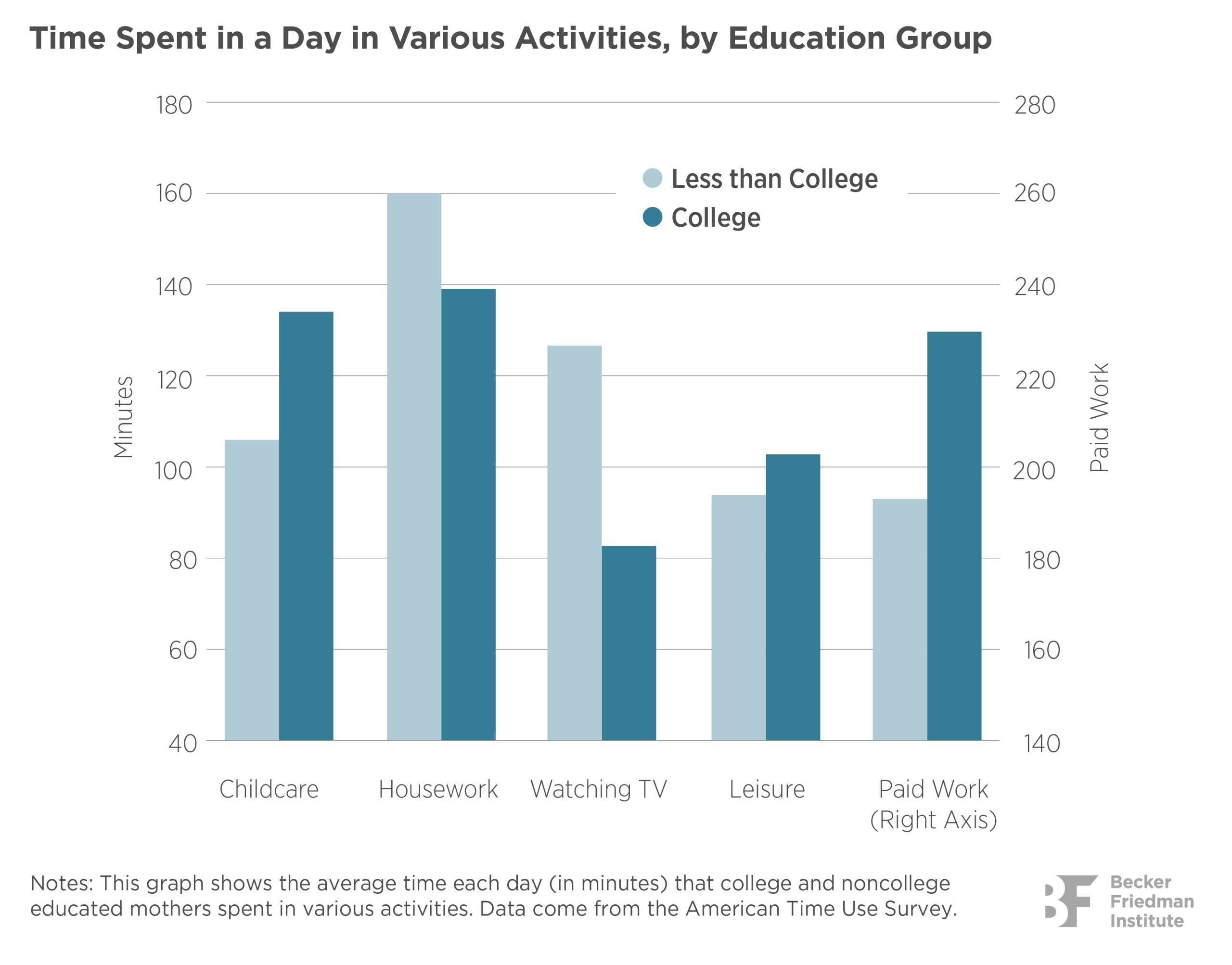
The authors study this question using data from the American Time Use Study Well-being Module. They focus on mothers because the survey’s sample of mothers is more generalizable than its sample of fathers or other caregivers, given differences in custody and single parenthood by race/ethnicity and income. The authors use data from the 2010, 2012, 2013, and 2021 iterations of the survey, in which mothers reported both their time spent on different activities, as well as how happy, meaningful, tired, stressed, sad, and in pain they felt during each activity. They found the following:
- All mothers report higher positive feelings when they spend time in childcare compared to other activities.
- Highly educated mothers report neither higher positive feelings nor lower negative feelings during intensive childcare than other mothers. In addition, college-educated mothers report significantly fewer positive feelings during time spent on management activities (which include picking up and dropping off children, and planning and organizing the child’s life outside the home), and significantly more negative feelings during time spent in educational activities (which include time in reading, talking, helping with homework, and other educational activities) with their child, compared to less educated parents.
- These results hold after controlling for a rich set of mother characteristics and life circumstances, such as family structure and health.
The authors’ findings provide no support for their hypothesis that more highly educated parents enjoy childcare more. Rather, their results suggest that factors beyond enjoyment must be driving the education disparity in parental time investment. For example, highly educated parents may perceive a higher return to their time investment. Indeed, prior studies have found that less educated mothers have lower subjective expectation about the impact of investment in child development and this partly explains education-based differences in childcare time.